GST rate & SAC code for coworking (997212)
The GST rate on coworking services, SAC code 997212 explained, and the place-of-supply rule that decides CGST/SGST vs IGST — with a worked example.
Two questions come up in almost every India coworking finance conversation: what GST rate applies, and which SAC code goes on the invoice. Both have a short answer that's right most of the time — 18%, and 997212 — and a longer answer that matters once your billing crosses a state line or your service mix gets less simple than a monthly desk fee. This guide is the rate-and-classification reference: what the code covers, how the tax splits between CGST/SGST and IGST, and the one rule — place of supply for immovable property — that causes more billing mistakes than everything else in this area combined. Our GST billing for coworking spaces guide covers the operator's full picture, including deposits, advances and input tax credit; this page goes deeper on rate and classification specifically.
This is general information, not tax advice. GST rates, SAC classifications and place-of-supply interpretations can change, and how they apply depends on your specific facts. Confirm your position with a qualified accountant before you rely on anything here.
The rate: 18%, generally
Coworking and shared-office supply is widely charged at 18% GST. The reasoning is that you're providing access to non-residential space, and that's treated as a supply of service — specifically, renting of non-residential immovable property — rather than a sale of goods. In practice this 18% is usually applied as a composite supply: the desk or membership fee bundled together with the facilities that come with it — internet, meeting-room access, power backup, reception, common-area upkeep — when they're sold as one package rather than itemised separately.
That last point is worth sitting with. If you bundle everything into one membership fee, the whole thing is taxed at 18% as a single supply. If you break a service out and bill it separately — say, hourly meeting-room hire charged on its own invoice to a non-member — its classification and rate can, in principle, differ. Most coworking operators bundle deliberately, partly because it keeps this question simple.
The SAC code: 997212
The Services Accounting Code most commonly used for coworking is 997212 — "Rental or leasing services involving own or leased non-residential property." It sits under the broader group 9972 (real estate services), within heading 99721 (real estate services involving own or leased property). You'll see it written as 9972 in some invoice templates and 997212 in others; the six-digit code is the more specific and generally the safer one to quote.
997212 covers the core of what a coworking operator sells: access to a desk, cabin or office within your premises, typically bundled with the facilities described above. It's the code you'll see cited across GST guidance for shared-office and flexible-workspace operators, and it's what our GST invoice format guide uses in its worked invoice example.
When a different code applies
997212 fits the core rental-of-space supply. It doesn't automatically cover everything a coworking business might invoice:
- Genuinely separable services — event-space hire billed independently of any membership, catering, printing sold à la carte, or business-support services offered as a distinct product — can sit under different SAC codes depending on what they actually are.
- Virtual-office and registered-address-only services, where no physical desk is involved, are sometimes treated differently from a physical seat, because the underlying supply isn't the same thing.
- Bundled packages that lean heavily toward a service other than space — a "concierge" or business-support membership where the desk is incidental — may be argued to fall under a different heading altogether.
None of this changes the 18% rate for the ordinary case. What it changes is the code on the line item, and classification here is genuinely fact-specific — it depends on exactly what you sell and how you bill it, not on a general rule this page can safely give you. If any part of your revenue looks like one of the above, get your accountant to confirm the code before you set up your invoice templates, not after your first GSTR filing throws up a mismatch.
The tax split: CGST + SGST, or IGST
The 18% is never just "18% GST" on the invoice — it's split into one of two pairs, and which pair applies is not a matter of choice:
| Supply type | Tax charged |
|---|---|
| Intra-state (place of supply is in the same state as your registration) | CGST 9% + SGST 9% |
| Inter-state (place of supply is in a different state from your registration) | IGST 18% |
The rate people usually get right. The split is where mistakes happen, because the split depends entirely on place of supply — and for coworking, place of supply does not work the way most people assume.
Place of supply: the rule that actually decides CGST/SGST vs IGST
Here is the single most misunderstood point in coworking GST, and it's worth being precise about it.
For services connected to immovable property, GST law fixes the place of supply as the location of the property itself — not the location of your business registration, and not the location of your customer's registration. A coworking desk or private cabin is access to physical space, so it's treated as a service connected to immovable property, and the place of supply is where that space physically sits.
That single rule decides everything downstream. It means a member's billing address, head-office state, or GSTIN state are all irrelevant to the tax split. Only one thing matters: where is the desk?
Worked example: same state, and a different one
Take an operator registered in Karnataka, running a location in Bengaluru. A client registered in Maharashtra books ten desks at that Bengaluru site for their team.
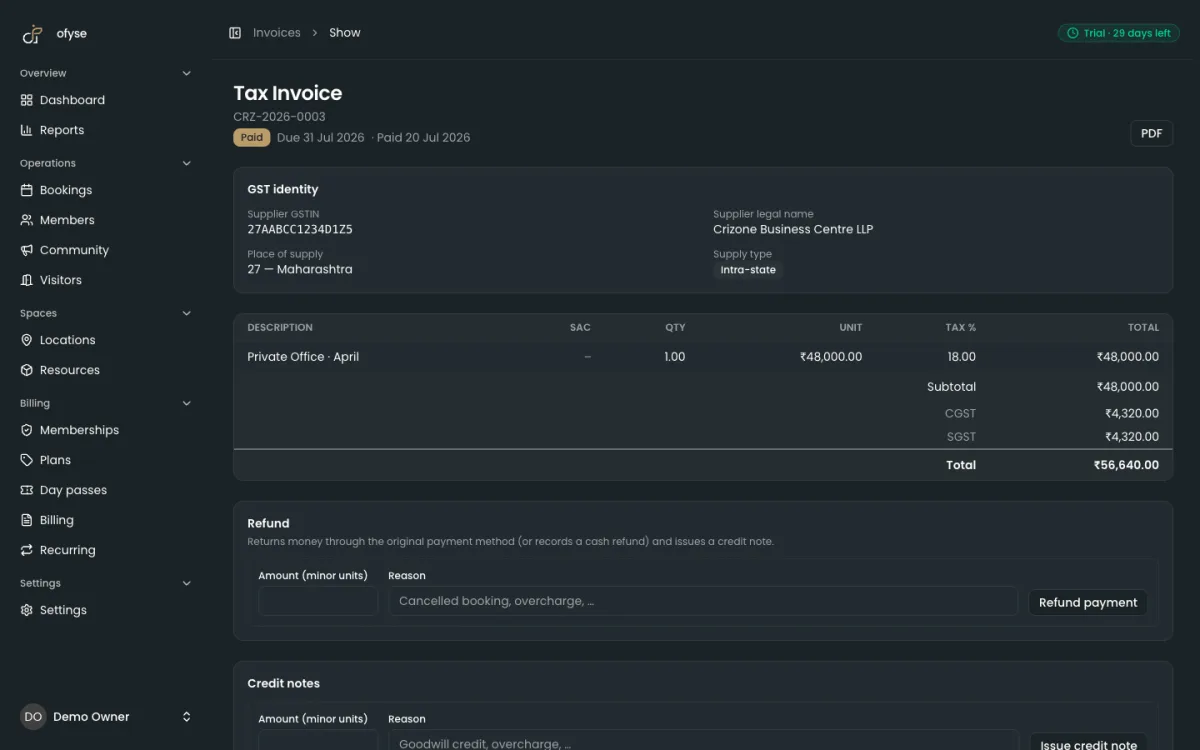
The intuitive — and wrong — assumption is that because the client is registered in a different state, this must be an inter-state supply, so IGST applies. It doesn't. Because the supply is connected to immovable property, the place of supply is Bengaluru — the location of the desks, not the location of the client's registration. The supplier is also registered in Karnataka. Same state on both sides of the transaction that actually governs the split, so this is an intra-state supply: CGST 9% + SGST 9%, even though the invoice is addressed to a Maharashtra-registered company.
| Field | Value |
|---|---|
| Supplier registration | Karnataka |
| Client registration | Maharashtra |
| Location of the desks (place of supply) | Karnataka (Bengaluru) |
| Tax charged | CGST 9% + SGST 9% — not IGST |
This is the pattern that trips up operators who default to "different registration state = IGST," a rule that's correct for a lot of ordinary B2B services but not for supplies tied to a specific piece of property. Get it backwards and you'll either overcharge tax that the client can't fully use as credit in the way they expect, or issue an invoice that doesn't match what their input-tax-credit statement shows — either way, it turns into a support conversation weeks later when someone reconciles GSTR-2B.
The only scenario where IGST genuinely applies to a coworking supply is where your location and the client are in different states — for example, a Delhi-registered operator invoicing desks at their own Mumbai location: place of supply is Maharashtra, the operator's registration is Delhi, so that's inter-state, IGST 18%. What decides it is always where the physical space sits relative to your own registration — never the client's.
Why this matters beyond getting the invoice right
Getting the split wrong doesn't just risk a correction later — it can affect whether your member can use the credit at all. A GST-registered client generally claims input tax credit against tax charged in the state where it was correctly reported. An invoice with the wrong split, or a place of supply left blank or defaulted to the client's address, can produce a credit that doesn't reconcile cleanly against what the client expected, particularly for larger clients booking desks across several of your cities. Reversing that after the fact — a credit note, a corrected invoice, a re-filed return — costs more in administrative time than getting it right the first time would have.
How ofyse applies this automatically
Manually tracking place of supply per invoice works until you have more than a handful of locations, or a client with desks in two of your cities on the same account. ofyse applies region-aware tax based on each location's registered state, so the CGST/SGST-versus-IGST split follows the property, not the client's billing address, on every invoice it generates. SAC codes sit on the line item, HSN/SAC handling is built in, and the same engine that gets the split right for a single desk gets it right across multiple locations run from one workspace. For the fields a fully compliant invoice needs and a worked sample, see the GST invoice format guide; for e-invoicing once your turnover crosses the current threshold, see IRN e-invoicing for coworking; and for the operator's full GST picture — deposits, advances, recurring seats — see GST billing for coworking spaces. If you're comparing tools on how well they handle this, our India billing software guide covers what to look for.
Rate and code are the easy part to memorise. Place of supply is the part worth checking on your own invoices today — and, as always, worth confirming with your accountant before you rely on it.
Frequently asked questions

Run your space the modern way
Bookings, members, memberships and billing in one workspace. Start a 30-day free trial — no card required.